
Key Takeaways
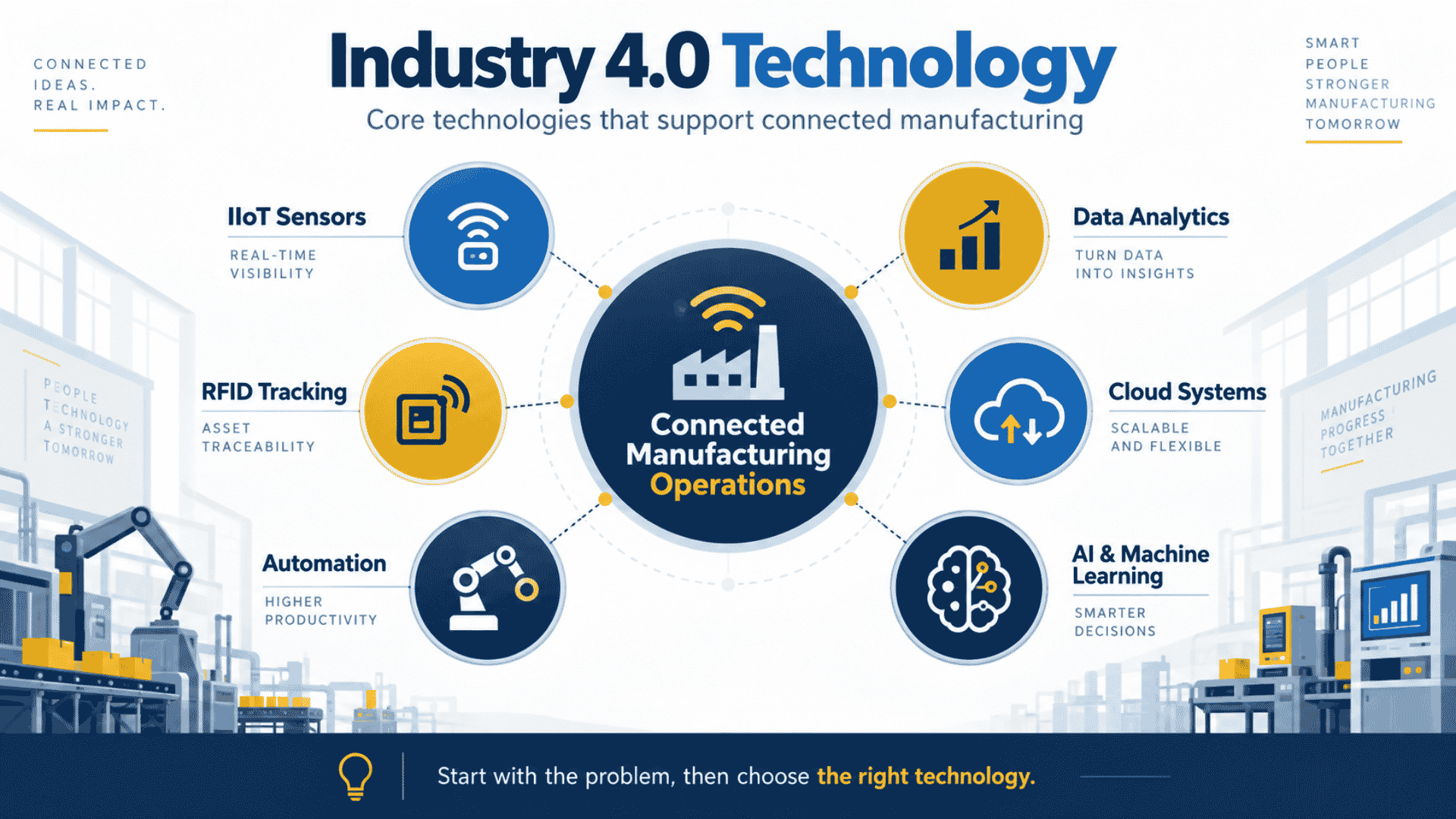
- Industry 4.0 is connectivity between equipment, software, data, and people — not a single new platform
- Start with a defined operational problem, then choose RFID, integration, sensors, or automation to fit it
- Connecting what you already run is often more useful than replacing the whole technology environment
- Dashboards and AI only help when the underlying data and system ownership are reliable
- Iowa manufacturers may qualify for up to $75K, but the CIRAS assessment request deadline is November 20, 2026
Manufacturers hear a lot about Industry 4.0 technology, smart manufacturing, connected factories, automation, AI, sensors, and digital transformation.
The terms can make the shift sound bigger and more complicated than it needs to be.
In practical terms, Industry 4.0 technology is about connecting equipment, software, data, and business systems so manufacturers can improve how work moves through the operation.
That may mean tracking inventory more accurately, reducing manual data entry, getting better production visibility, detecting equipment problems earlier, or connecting systems that currently operate in isolation.
For many manufacturers, the right starting point is not a new technology platform. It is identifying an operational problem worth solving and then choosing the technology that fits.
This guide explains what Industry 4.0 technology means, the technologies most commonly involved, where they create practical value, and how manufacturers can decide where to start.
What Is Industry 4.0 Technology?
Industry 4.0 refers to the use of connected digital technologies across manufacturing operations. The goal is to create better communication between machines, systems, data, and people.
That can include technologies such as:
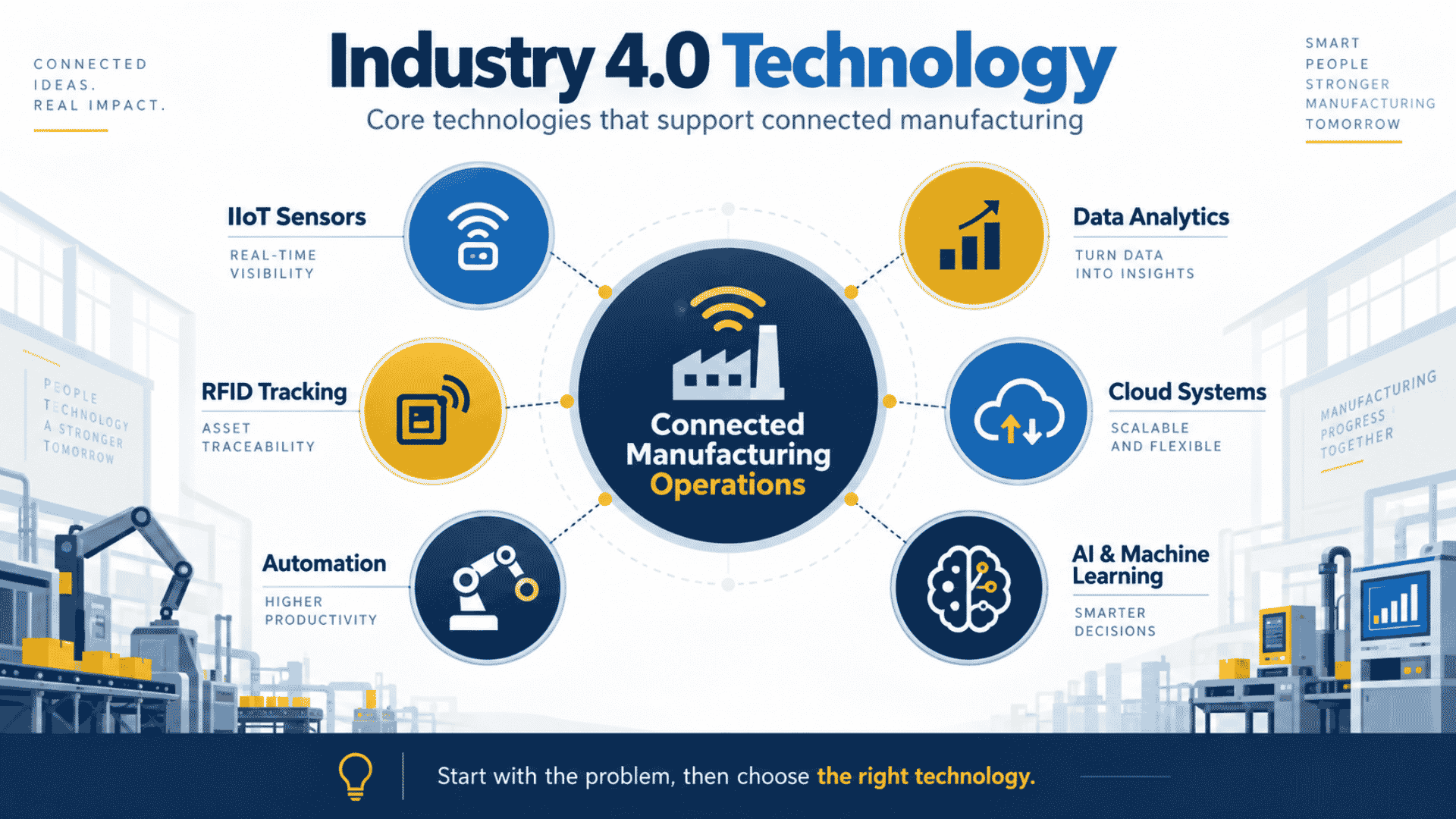
- Industrial IoT sensors
- Manufacturing automation
- RFID
- Data analytics
- Cloud infrastructure
- AI and machine learning
- Predictive maintenance
- Robotics
- System integration
- Real-time operational dashboards
NIST describes Industry 4.0 and advanced manufacturing as including technologies such as artificial intelligence, robotics, additive manufacturing, digital twins, data analytics, cybersecurity, and connected manufacturing systems.
The technology matters, but the bigger idea is connectivity.
A manufacturer may already have an ERP, production equipment, databases, inventory software, and spreadsheets. If those systems do not exchange information effectively, employees still have to move data manually between them.
Industry 4.0 aims to reduce that friction.
Industry 4.0 vs. Traditional Manufacturing Technology
| Traditional approach | Industry 4.0 approach |
|---|---|
| Systems operate independently | Systems exchange information |
| Equipment is checked manually | Equipment can be monitored through connected sensors |
| Maintenance is largely reactive | Data can support predictive maintenance |
| Inventory is checked manually | RFID and connected tracking improve visibility |
| Reports are generated periodically | Operational data can be viewed more quickly |
| Employees move information between systems | Integrations automate data flow |
Industry 4.0 does not mean every manufacturer needs to replace its equipment or rebuild its technology environment. In many cases, the opportunity is to connect and improve what is already there.
What Technologies Make Industry 4.0 Possible?
There is no single Industry 4.0 platform. Most projects combine several technologies depending on the operational problem being addressed.
Industrial Internet of Things and Sensors
Industrial Internet of Things, or IIoT, refers to connected equipment, sensors, and devices that collect and exchange operational information.
Sensors can be used to monitor machine temperature, vibration, equipment condition, production activity, energy usage, environmental conditions, and material movement.
For example, instead of relying only on scheduled inspections, a manufacturer could use sensors to continuously monitor equipment conditions and identify changes that may require attention.
The value is not the sensor itself. The value comes from collecting useful information and connecting it to a process where someone can act on it.
Manufacturing Automation
Manufacturing automation can involve equipment, software, workflows, robotics, or a combination of technologies.
Some projects focus on physical production. Others focus on information flow.
Examples include automating repetitive production tasks, moving information automatically between systems, triggering notifications when specific conditions occur, reducing manual data entry, automating routine approvals, and connecting production systems with ERP or inventory platforms.
The strongest automation projects usually begin with a repetitive process that is already understood. Automating a poorly defined process can simply make the same problem happen faster.
RFID and Real-Time Tracking
RFID can help manufacturers improve visibility into inventory, materials, equipment, and work in progress.
RFID tags and readers can help identify where an item is without requiring the same level of manual scanning or physical searching.
Potential use cases include raw material tracking, inventory management, work-in-progress visibility, tool and equipment tracking, finished goods tracking, and material movement between locations.
For manufacturers still relying heavily on spreadsheets or manual inventory checks, RFID can provide a practical first step toward more connected operations.
Data Analytics and Visualization
Manufacturers create large amounts of operational data. The challenge is often not collecting more data. It is making the existing data useful.
NIST notes that smart manufacturing depends heavily on data and that manufacturers often struggle with collecting, integrating, governing, and using it effectively.
Data analytics can help teams identify patterns across production, quality, inventory, maintenance, equipment utilization, throughput, downtime, and supply chain activity.
Visualization tools can then turn that information into dashboards and reports that employees can actually use.
A dashboard is only useful, however, if the underlying data is trustworthy. Poor data quality does not become better simply because it is presented visually.
Cloud and Connected Systems
Cloud platforms can provide infrastructure for centralized data access, application hosting, integration, analytics, backup, collaboration, and scalable computing.
But Industry 4.0 does not require every manufacturing workload to move to the cloud.
In many environments, a hybrid approach makes more sense. Some systems may remain on premises while selected applications, integrations, analytics, or data services move to the cloud. A planned cloud migration is often more practical than forcing every system into the same model.
The goal should be to create a technology architecture that supports the operation.
AI and Machine Learning
AI is becoming increasingly relevant to smart manufacturing, but it depends heavily on data quality, integration, and reliable operational systems.
NIST smart manufacturing programs highlight applications including industrial data analytics, advanced sensing, autonomous systems, digital twins, robotics, supply chain optimization, and manufacturing decision support. They also note challenges involving industrial data, system integration, explainability, and reliability.
Potential manufacturing AI use cases include predictive maintenance, quality inspection, anomaly detection, demand forecasting, production optimization, knowledge retrieval, and document processing.
AI should usually come after the manufacturer understands the business process, the available data, and the systems that need to work together.
Predictive Maintenance
Predictive maintenance uses equipment data to identify signs that a machine may require attention before a failure occurs.
It may combine sensors, machine data, historical maintenance records, analytics, alerts, and AI or machine learning.
For example, a change in vibration or temperature may indicate that equipment should be inspected earlier than originally scheduled.
The goal is not to eliminate every equipment failure. It is to give operations and maintenance teams better information about when intervention may be required.
System Integration
System integration is one of the less visible parts of Industry 4.0, but it is often one of the most important.
A manufacturer may have strong individual systems that still create inefficient operations because they do not communicate.
Examples include ERP and inventory systems, CRM and quoting applications, production databases, warehouse systems, custom software, equipment data, and reporting applications.
If employees repeatedly export a spreadsheet from one system, clean the information, and upload it into another system, that is often an integration problem.
Connecting systems can reduce those handoffs and improve information flow across the business. That work is often a custom software and integration project, not a new platform.
What Does Industry 4.0 Look Like in a Real Manufacturing Business?
The useful version of Industry 4.0 starts with a specific operational problem, then matches a technology approach to a measurable outcome.
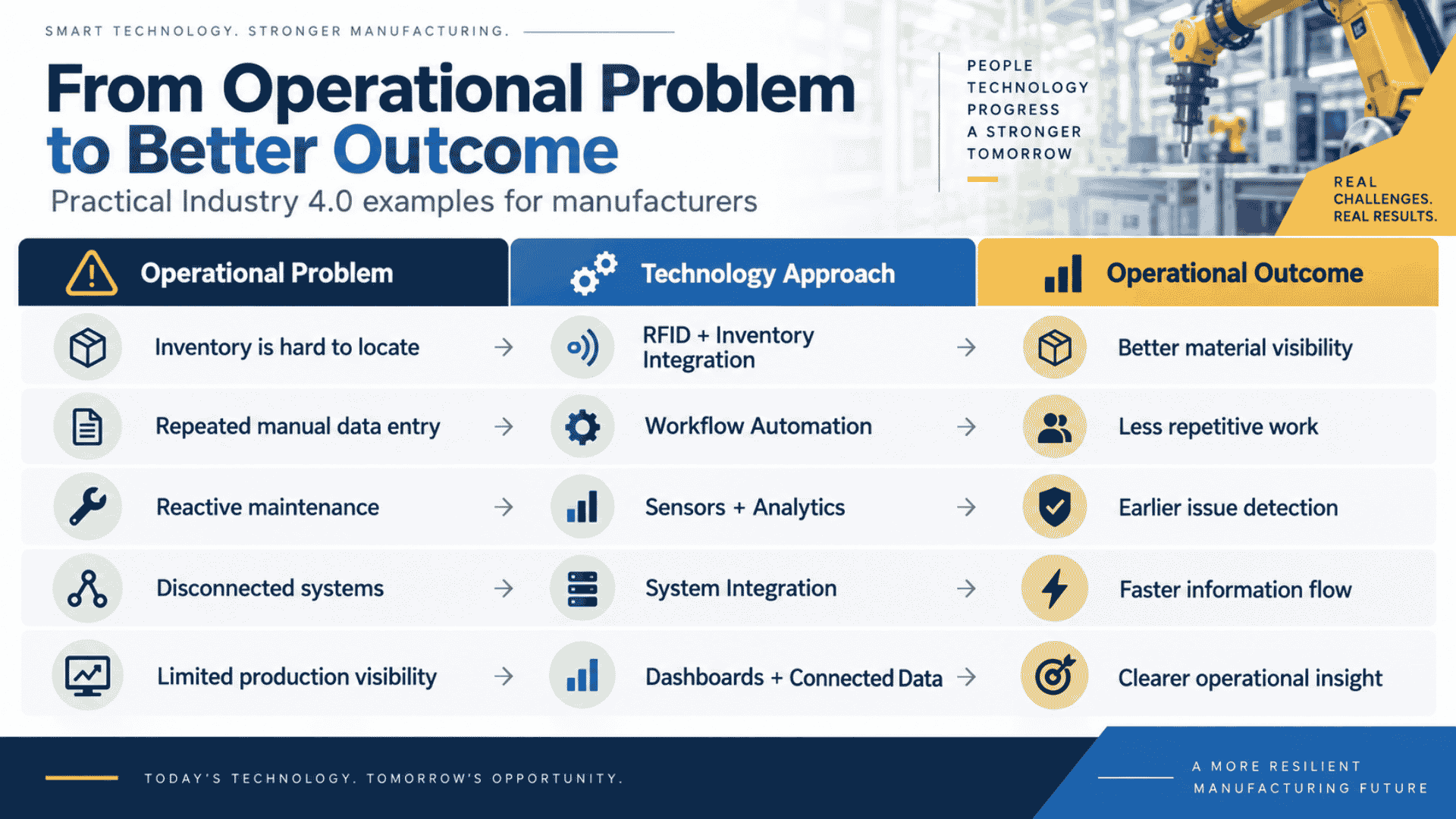
Problem: Inventory Is Difficult to Locate
Possible approach: RFID, inventory software, and ERP integration.
Potential operational outcome: Improve visibility into where inventory is and reduce manual searches.
Problem: Production Information Lives in Multiple Systems
Possible approach: System integration, centralized operational data, and dashboards.
Potential operational outcome: Reduce manual handoffs and provide faster access to operational information.
Problem: Maintenance Is Mostly Reactive
Possible approach: Sensors, machine monitoring, and analytics.
Potential operational outcome: Give maintenance teams more information about equipment conditions and help identify problems earlier.
Problem: Employees Enter the Same Information More Than Once
Possible approach: Workflow automation and system integration.
Potential operational outcome: Reduce duplicate work and lower the risk of transcription errors.
Problem: Management Lacks Production Visibility
Possible approach: Connected operational data, dashboards, and automated reporting.
Potential operational outcome: Provide more timely information about production performance.
What Are the Business Benefits of Industry 4.0 Technology?
Better Operational Visibility
Connected data can make it easier to understand what is happening across equipment, production, inventory, and workflows.
Less Repetitive Manual Work
Automation and integration can reduce the number of tasks employees perform simply to move information between systems.
Faster Access to Information
Connected systems can reduce the time employees spend searching for data or compiling reports.
Better Inventory and Material Tracking
RFID and connected inventory systems can improve visibility into raw materials, work in progress, and finished goods.
Reduced Unplanned Downtime
Equipment monitoring and predictive maintenance can help teams identify issues before they become larger problems.
Easier Scalability
Processes that depend heavily on manual steps often become harder to manage as the organization grows. Automation and integration can make those processes easier to scale.
None of these outcomes come automatically from buying technology. Results depend on choosing the right problem, building the right integration, using reliable data, and making sure employees can work effectively with the new process.
Common Industry 4.0 Challenges Manufacturers Should Plan For
Legacy Systems Can Be Difficult to Integrate
Older applications may not have modern APIs or straightforward integration options. That does not automatically mean they need to be replaced. Sometimes an integration layer, database connection, or phased legacy modernization approach is more practical.
Data May Be Incomplete or Inconsistent
Manufacturers often discover that data quality becomes a bigger issue once they start connecting systems. Duplicate records, inconsistent naming, missing fields, and spreadsheet-based processes can reduce the value of analytics and automation.
More Connectivity Creates More Security Considerations
Connecting equipment, applications, and cloud services increases the importance of cybersecurity. Access controls, network segmentation, identity management, monitoring, software updates, and vendor risk all become part of the technology decision.
Technology Is Sometimes Chosen Before the Problem Is Defined
A manufacturer may decide it needs AI, robotics, or IoT before identifying the business problem. Technology should be selected because it solves a defined operational issue.
Trying to Modernize Everything at Once
Large transformation projects create risk. A smaller project with a clear outcome can provide useful experience and demonstrate value before the manufacturer expands the approach.
Nobody Owns the System After Go-Live
A project should have clear ownership for monitoring, data, support, access, and future changes. Implementation is not the end of the technology lifecycle.
Where Should a Manufacturer Start With Industry 4.0?
- 1Identify the operational problem. Start with where employees lose time, where manual work repeats, where information is difficult to access, where systems are disconnected, where delays occur, or where visibility is limited.
- 2Understand the current systems and data. Document the ERP, databases, production systems, inventory software, spreadsheets, equipment, custom applications, and cloud platforms already in place.
- 3Define the desired business outcome. Make the goal specific. For example, reduce the time employees spend locating work-in-progress inventory, or eliminate duplicate order entry between the ERP and production system.
- 4Select the technology based on the problem. Evaluate RFID, integration, automation, sensors, analytics, cloud infrastructure, custom software, or other technology only after the business requirement is clear.
- 5Start with a manageable project. Use a focused project to understand integration requirements, user adoption, data issues, support needs, and business impact before expanding.
- 6Plan for integration and ownership. Decide what systems connect, who owns the solution, how data is maintained, who supports it, and how employees will use it.
Industry 4.0 Technology for Small and Mid-Sized Manufacturers
Industry 4.0 is sometimes presented as something only large global manufacturers can afford. That does not have to be the case.
A small or mid-sized manufacturer does not necessarily need a completely new factory, a new ERP, full robotics across production, an enterprise-wide AI platform, or hundreds of connected devices.
A practical Industry 4.0 project may be much smaller:
- Add RFID tracking to one inventory process
- Connect two systems that currently require manual data entry
- Build a production dashboard using existing data
- Add sensors to critical equipment
- Automate a repetitive administrative workflow
- Modernize one legacy application
- Move selected infrastructure to the cloud
- Improve reporting across existing systems
Starting with a clearly defined operational problem can reduce risk and make it easier to demonstrate value. Letter B services cover the software, integration, and modernization work that follows that decision.
Funding Industry 4.0 Technology in Iowa
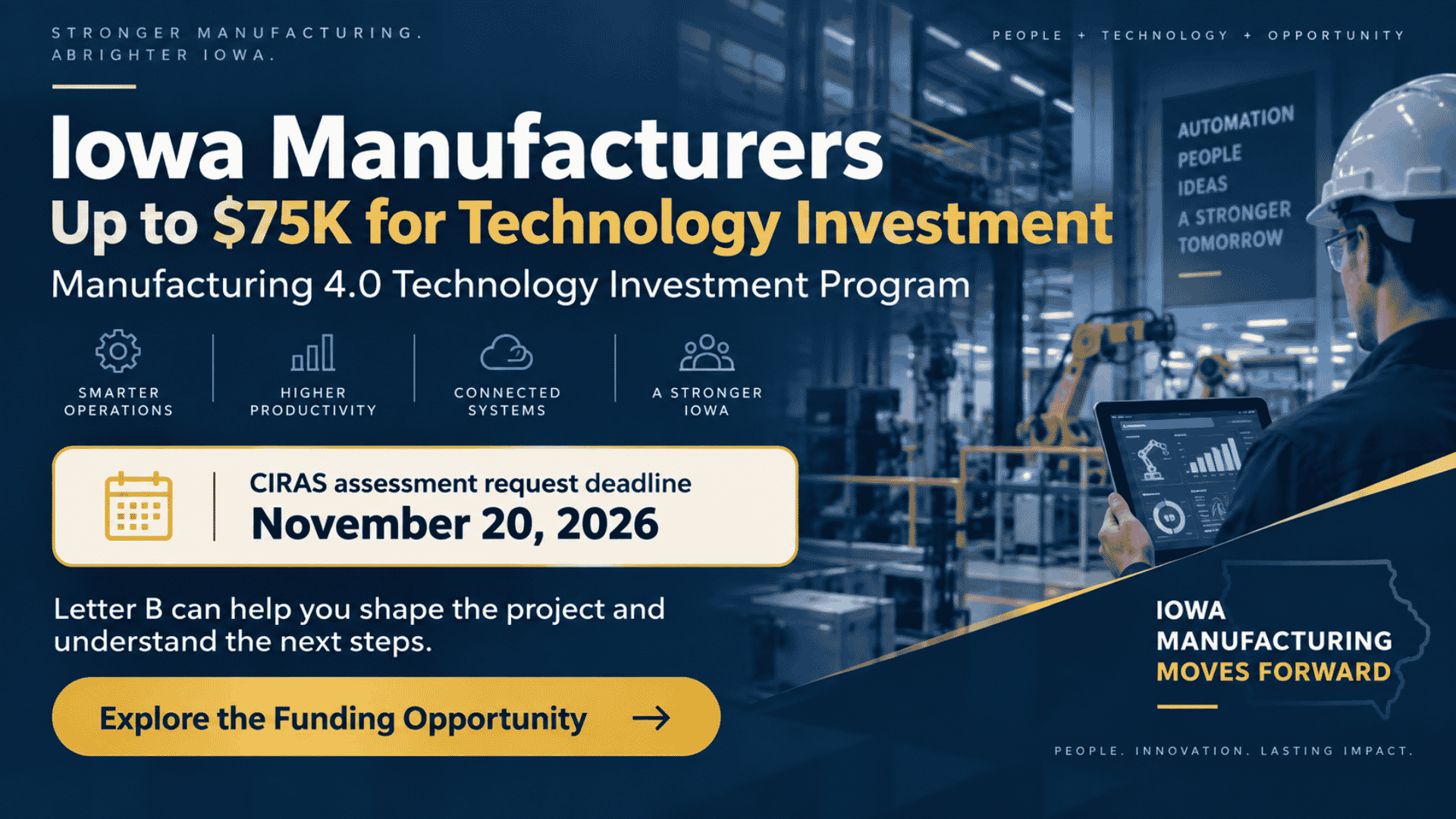
Iowa manufacturers considering Industry 4.0 projects may currently have access to funding through the Manufacturing 4.0 Technology Investment Program.
The program supports eligible smart manufacturing investments including automation equipment, IIoT infrastructure, cybersecurity software, predictive maintenance, sensor integration, data analytics, data visualization, cloud-enabling infrastructure, and RFID tracking.
Eligible companies can apply for up to $75,000 over the lifetime of the business, with a 1:1 match requirement. Before applying, manufacturers must complete a Manufacturing 4.0 Assessment through CIRAS. The last day to request the assessment for the current round is November 20, 2026, and applications are scheduled to open January 4, 2027, and close January 29, 2027.
The program is statewide and is intended for eligible Iowa manufacturers. Because the CIRAS assessment is required before application, manufacturers considering a project should begin before the November assessment-request deadline.
If your organization is exploring automation, RFID, data, system integration, cloud infrastructure, or another manufacturing technology initiative, Letter B can help you think through the project, define the technology requirements, and coordinate with CIRAS where appropriate.
Industry 4.0 Is a Business Improvement Strategy, Not a Technology Checklist
Industry 4.0 is often described through technologies such as AI, IoT, robotics, sensors, cloud computing, and automation.
But manufacturers do not become more effective simply by adding more technology.
The real value comes from understanding where the operation is experiencing friction and choosing technology that addresses that problem.
Start with the process. Understand the systems and data already in place. Define the business outcome. Then decide which technology can improve the way the operation works.
For some manufacturers, that may mean AI or predictive maintenance. For others, it may be as practical as connecting two systems, improving inventory tracking, or eliminating a repetitive spreadsheet process.
That is often where Industry 4.0 creates its most useful impact.
Enjoyed this insight?
Explore how Letter B turns the same challenge into an operational win.
Related insights
View all
Where Modern Manufacturing Technology Replaces Legacy Systems in Manufacturing in 2026
Modern manufacturing technology does not require replacing everything at once. Many improvements focus on the areas where inefficiencies hav...
Read article
Kick Start Q1 Efficiency: How Midwest Manufacturers Can Integrate Quoting, Inventory, and ERP for a Strong Start to 2026
For many small and mid-sized Midwest manufacturers, the first quarter sets the tone for the entire year. After year-end reporting, budget re...
Read article
Digital Manufacturing Resolutions for 2026: Start the New Year With Connected, Modern Systems
As the year comes to a close, manufacturers across the Midwest are already planning for 2026. Many share the same goals: improve efficiency,...
Read article