
Smart manufacturing sounds like something built for a plant with robots on every line and a seven-figure technology budget. Most of the projects that earn the name are far smaller than that.
One shop connects two systems so nobody has to retype an order. Another adds sensors to three machines to watch for signs of wear. A third puts RFID tags on raw material so the inventory count stops being a guess. None of that changes what the plant makes. It changes how well the people running it can see what is going on.
That is the whole idea. Smart manufacturing is not about adding technology to the shop floor. It is about getting better information out of it.
Iowa manufacturers: grants of up to $75,000 are open through the Manufacturing 4.0 Technology Investment Program, and the CIRAS assessment you need before applying must be requested by November 20, 2026. There is a short summary near the end of this guide, or see our Iowa Manufacturing 4.0 funding page.
Key takeaways
- Smart manufacturing means using connected systems and shared data to run a plant with better information, not just newer machines.
- The difference from traditional manufacturing is usually how information moves, not what equipment is on the floor.
- Most projects fall into five buckets: system integration, sensors, RFID and barcode tracking, dashboards, and predictive maintenance.
- Connecting the systems you already own often returns more than buying another one.
- Start with one operational problem you can measure. Plant-wide programs are where this goes wrong.
- Iowa manufacturers may be able to offset part of the cost through Manufacturing 4.0 funding.
What is smart manufacturing?
Smart manufacturing is the use of connected technology, data and systems to improve how a plant is monitored, managed, and improved. In practice, it pulls together a handful of familiar tools:
- Sensors on machines and equipment
- Connected machines and shop floor terminals
- ERP and other business systems
- RFID and barcode tracking
- Cloud platforms
- Dashboards and reporting
- Automation
- Analytics
The key word is connected. In a smart manufacturing setup, information moves between machines, systems and people instead of sitting in separate tools and spreadsheets. Production data feeds a dashboard on its own. Inventory activity updates the business system. Machine data tells the maintenance team something is changing before the machine stops. NIST has described it as production systems that respond in real time to what is actually happening across the floor, the supply network and the customer.
Smart manufacturing is not a product you buy. There is no box with the word on it. It is a way of getting more out of the equipment, systems and data you already have, one connection at a time.
Smart manufacturing vs traditional manufacturing
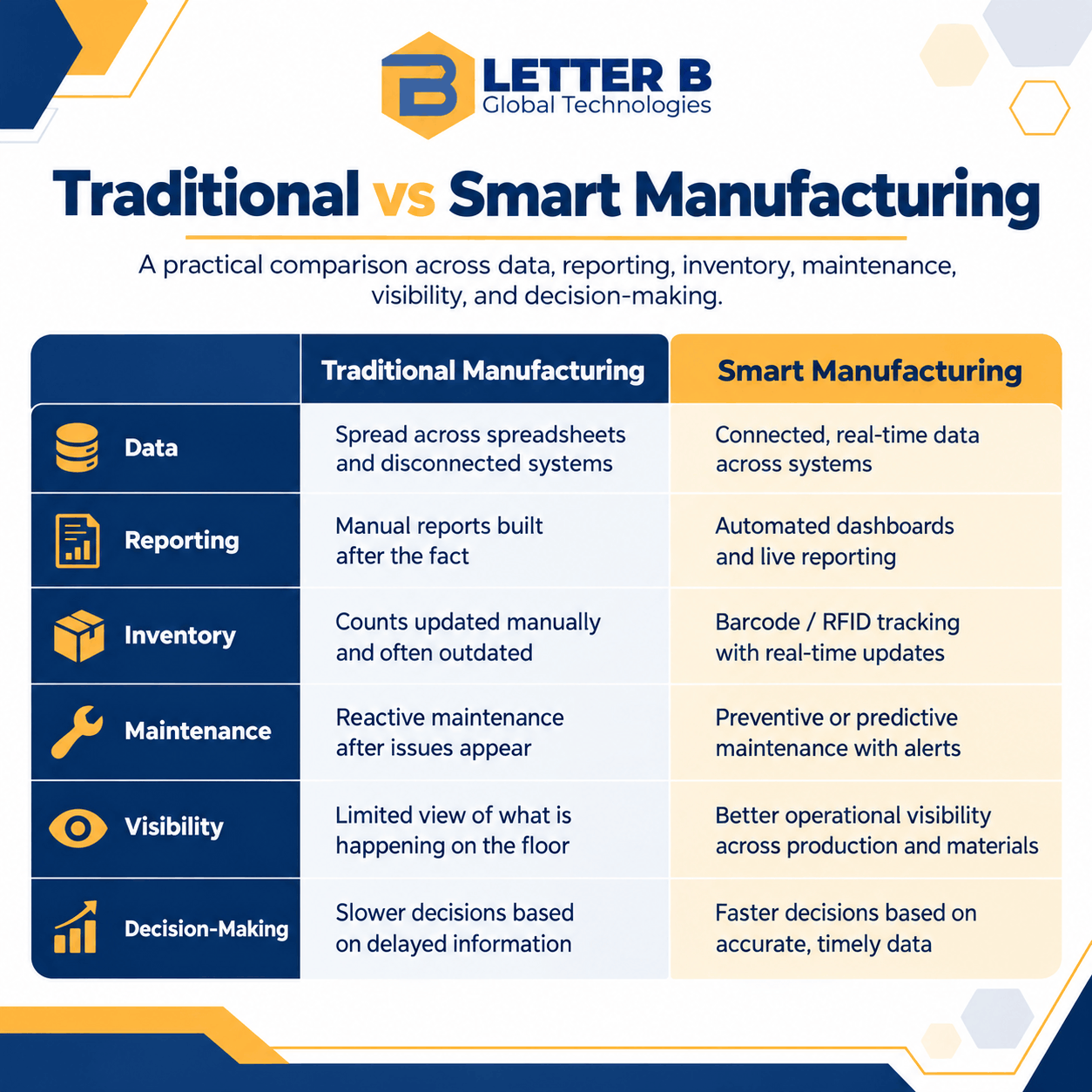
A traditional plant can be full of modern equipment. The difference is usually not the machines. It is whether information gets where it needs to go without someone carrying it there.
| Traditional manufacturing | Smart manufacturing |
|---|---|
| Data sits in separate systems | Data is shared across connected systems |
| Reports are built by hand | Reports update on their own |
| Inventory depends on manual counts | Inventory is tracked digitally as it moves |
| Maintenance is reactive or on a fixed schedule | Machine data supports predictive maintenance |
| Production information arrives late | Teams see current production data |
| People move information between systems | Systems exchange information directly |
None of this is about removing people. It is about giving them better information and taking back the hours they spend being a bridge between two systems that should talk to each other.
Why connected systems matter more than new ones
Most manufacturers we meet are not short of software. They have an ERP, an inventory system, production tools, shipping software, a quality system, a few custom applications and more spreadsheets than anyone wants to admit. The problem is that none of it is connected.
Here is what that looks like in practice. An order arrives in one system. Someone retypes it into the ERP. Someone else updates a spreadsheet. Production hears about it by email. Inventory gets adjusted separately. On Friday a manager pulls numbers from four places to build a report that is already a day behind.
Every handoff in that chain is a chance for a delay, a typo, or two versions of the truth. A connected process moves the same information with far less effort:
Customer order → ERP → production → inventory → shipping → reporting
This is why system and API integration is usually the highest-value place to start. It is also why the question to ask before buying anything is: can the systems we already own work better together? Connecting what you have tends to return more than adding a tenth application, and it does not ask your team to learn another screen.
We built this kind of integration layer for an MSP client to automate vendor syncing and the manual checks around it, which took weeks out of their delivery timeline. The OnPart case study has the detail.
How IoT sensors support smart manufacturing
Sensors are the most common entry point, because they add data without changing how the machine runs. Depending on the process, they can track temperature, pressure, vibration, machine status, production counts, equipment condition or energy use.
Collecting the data is the easy part. The value shows up only when someone can act on it. A vibration reading that climbs over two weeks is useful if it reaches the maintenance team as an alert. It is worth nothing if it sits in a log file nobody opens.
The same holds for production counts. Instead of waiting for an operator to write numbers on a clipboard and someone to key them in later, sensors and shop floor terminals give you a current picture of what is actually running. That is often the first time a plant can answer "how are we doing today?" before the day is over.
A practical note on scope: you do not need sensors on every machine. Start with the ones where a stoppage costs the most, or where you already suspect a problem. Three well-chosen machines will teach you more than thirty.
How RFID is used in smart manufacturing
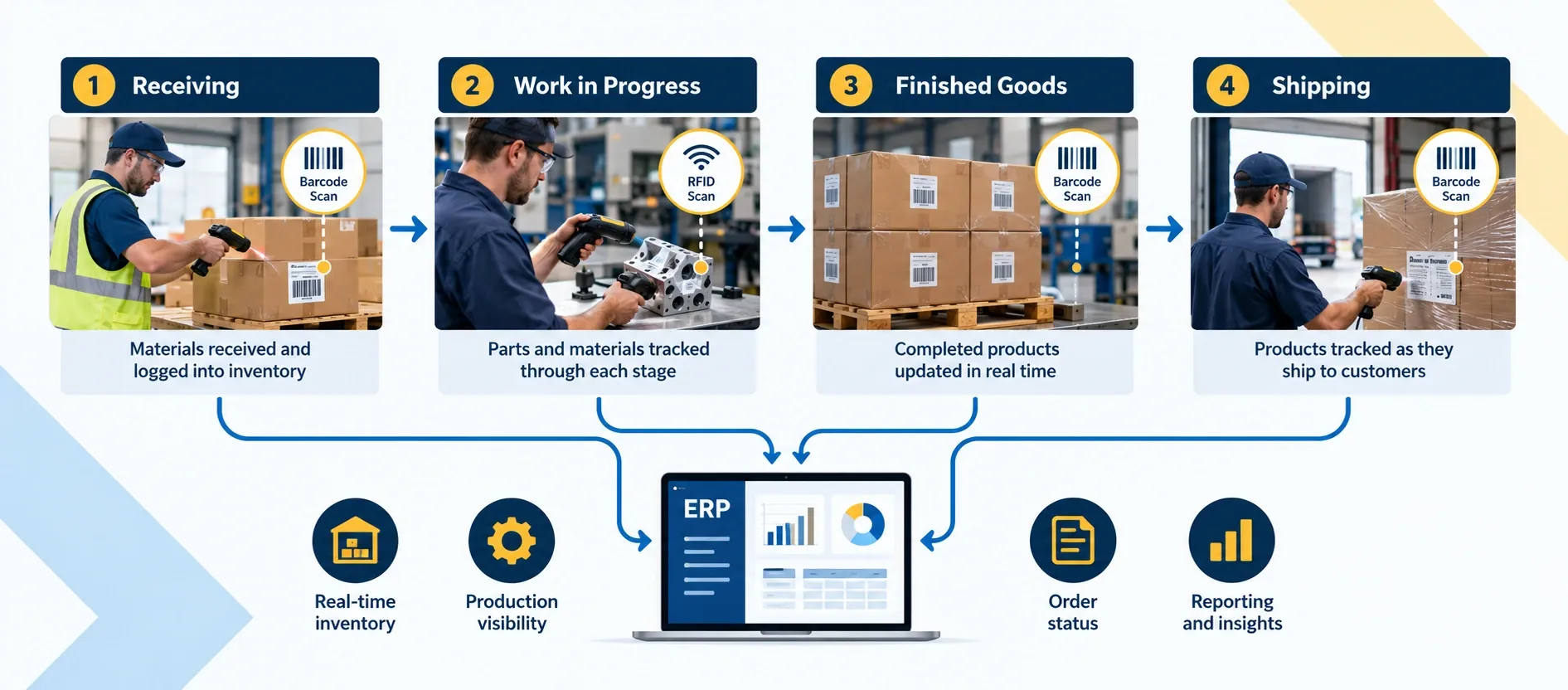
RFID helps you track materials, inventory, tooling and work in progress. Unlike a manual count, it captures information as tagged items move, so the record keeps up with the floor. Common uses include raw material tracking, work in progress, finished goods, tools and equipment, inventory locations, and shipping and receiving.
A manufacturer might tag parts as they move between storage, production and shipping, with each read feeding the inventory or business system. The manual update disappears, and so does the gap between what the system says and what is actually on the rack. For plants where the count is accurate on Monday and questionable by Thursday, inventory and RFID tracking is often the most practical first project, because the result is visible within weeks.
How smart manufacturing improves data visibility
Most manufacturers already collect plenty of data. It is just spread across machines, spreadsheets, business systems and individual departments, which makes simple questions surprisingly hard to answer:
- What is running right now?
- Which job is behind?
- Where is that material?
- Are the inventory numbers accurate?
- Is any machine showing signs of trouble?
- Where is the bottleneck today?
If the honest answer to several of those is "let me check and call you back," that is the gap. Dashboards, connected systems, sensors and automated reporting bring the pieces together so the answer is on a screen instead of at the end of a walk through the plant.
This does not mean handing decisions to software. It means the people making the decisions are working from current information rather than last week's.
How smart manufacturing supports predictive maintenance
Maintenance is one of the clearest places connected data pays off. There are three common approaches, and most plants use a mix:
- Reactive. The machine fails and the team responds. Cheapest until it isn't.
- Preventive. Maintenance happens on a fixed schedule, whether or not the machine needs it.
- Predictive. Equipment data is used to spot a problem developing, so the work happens before the breakdown.
Predictive maintenance usually draws on vibration, temperature, runtime, pressure, performance against normal, and error patterns. When the data drifts away from the usual range, the team investigates before a part fails in the middle of a run.
It is worth being straight about the limits. Predictive maintenance does not eliminate breakdowns. What it does is move some of them from surprise to scheduled, which is where the money is: a planned two-hour stop costs a fraction of an unplanned one on a Friday afternoon.
What cloud-connected manufacturing means
Cloud-connected manufacturing means selected plant data and systems link to cloud-based tools, so information can be brought together and reached from anywhere. Typical uses are production dashboards, reporting, data from several locations in one view, inventory visibility, maintenance data and analytics.
This matters most for multi-site operations. If each plant reports separately, nobody has a current view of the business. We built a unified cloud architecture for a client that enabled real-time production tracking across facilities, which removed the inventory blindspots and the system desynchronization they had been working around. The enterprise operations case study covers how that was put together.
It is also worth saying what cloud-connected does not mean. It does not mean everything moves to the cloud. Most manufacturers run a mix of shop floor systems, local infrastructure, edge devices and cloud platforms, and that mix is usually the right answer. What belongs where depends on your operation, your existing systems, your security requirements and the kind of data involved. Cloud migration and database migration projects in manufacturing nearly always end up as a blend rather than a lift-and-shift.
Practical examples of smart manufacturing
The concept gets much easier to grasp when you start from the problem rather than the technology.
| Business problem | Smart manufacturing approach |
|---|---|
| Inventory records are usually out of date | RFID or barcode tracking connected to the inventory system |
| Managers wait on manual production reports | Production data feeding an automated dashboard |
| Equipment failures are hard to see coming | Sensors monitoring machine condition |
| Staff enter the same information in several systems | System integration with automatic data transfer |
| Production and inventory data live apart | Production systems integrated with ERP or inventory tools |
| Nobody can see current job status | Connected production tracking on the floor |
| Each location reports separately | Centralized reporting through cloud-connected systems |
The technology will be different at every plant. The starting point should not be.
Why smart manufacturing projects fail
Most plant managers have watched a technology project go sideways, so it is worth naming the patterns. These are the ones we see most often.
Buying a platform before defining the problem. A system chosen from a demo rather than from a specific operational gap tends to arrive, get configured, and then get worked around. Start from the problem and the shortlist gets much shorter.
Connecting everything at once. A plant-wide program has a long gap between the spend and the first visible result, and support drains away in that gap. One connected process that works is worth more than five that are half-finished.
Leaving operators out of the design. The people doing the work know where the process actually breaks and which workarounds exist. They also decide whether the new system gets used properly or quietly bypassed. Bring them in before the design is locked, not at training.
Automating a broken process. If a workflow is confusing today, connecting it just makes the confusion travel faster, and now it is written into software. Map it, cut the steps that exist for no reason, then automate what is left.
No measurement. Decide what success looks like before you start: hours of manual entry removed, inventory accuracy, report turnaround, unplanned downtime. Without a before-and-after number you cannot tell whether it worked, and you will struggle to get the next project approved.
Where smaller manufacturers should start
A first project does not need to be ambitious. It needs to solve a real problem, show a measurable result, and leave something the next project can build on.
In practice that means picking one process where work is slow, repetitive, hard to track or dependent on manual updates. Map how it runs today, including which systems are involved and where people spend time moving information around. Then look at whether connecting what you already own would fix it before you look at buying anything.
Choosing between several candidate projects is its own exercise, and we covered it in more depth in our guide to manufacturing automation and what to automate first, which includes an impact-versus-effort framework for ranking them.
If AI is also on the table, the same logic applies and the groundwork matters more. Our AI readiness assessment looks at whether your data, systems and workflows can actually support it before anyone commits budget.
Funding for Iowa manufacturers
Iowa manufacturers planning a smart manufacturing or Industry 4.0 investment may be able to offset part of the cost. The Manufacturing 4.0 Technology Investment Program from the Iowa Economic Development Authority supports small and mid-sized manufacturers adopting smart technologies in existing operations.
The short version: up to $75,000 over the lifetime of the business, a 1:1 cash match required, and an Industry 4.0 assessment from CIRAS at Iowa State completed before you apply. Eligible technology typically covers automation and robotics, sensors, IIoT infrastructure, predictive maintenance tools, data analytics and visualization, cybersecurity software, and RFID and inventory tracking.
The date that matters: the last day to request the CIRAS assessment is November 20, 2026. You can request it here, and our Iowa Manufacturing 4.0 funding page walks through eligibility, timing and what makes a strong application.
One caution. Funding is a good reason to move a project forward. It is a poor reason to invent one. If you already have an operational problem and a practical plan, this makes the investment much easier to approve.
Smart manufacturing starts with one good connection
You do not have to change every machine, system and process at once. Most of the plants that end up genuinely connected got there one project at a time.
A sensor that gives maintenance a week of warning. An RFID system that makes the inventory count trustworthy. An integration that ends duplicate data entry. A dashboard that surfaces a production problem the same morning it starts. Each one is small. Together they are the difference between running a plant on reports and running it on current information.
Thinking about a smart manufacturing project?
Letter B has built practical software for manufacturers since 2008: custom applications, ERP and API integration, RFID and inventory tracking, cloud systems and legacy modernization. We design around how your plant already runs instead of asking you to replace what works.
Book a strategy call, and we will look at the process you want to improve and what it would take to connect it. If you are in Iowa and weighing a Manufacturing 4.0 project, it is worth doing before the November 20 assessment deadline.
Related: Manufacturing solutions · Manufacturing automation: where to start · Iowa Manufacturing 4.0 funding · Modernizing enterprise operations case study · Legacy database migration case study
Frequently asked questions
What is smart manufacturing in simple terms?
It is using connected systems and shared data to run a plant with better information. Machines, software and people exchange information directly instead of someone carrying it between them by hand.
What is the difference between smart manufacturing and Industry 4.0?
They overlap heavily and are often used interchangeably. Industry 4.0 is the broader term for this wave of industrial technology, covering IIoT, automation, data and connected systems. Smart manufacturing usually refers to applying those ideas inside a plant.
Is smart manufacturing only for large factories?
No. Most of the projects that pay off at small and mid-sized plants are narrow ones: connecting two systems, tracking inventory with RFID, adding sensors to a few critical machines, or building a dashboard that replaces a manual report.
What is a good first smart manufacturing project?
One that solves a problem you can measure. Inventory tracking and system integration are common starting points because the result shows up quickly and both create a data foundation later projects can use.
Do we need to replace our ERP to do this?
Usually not. In most cases the better first step is connecting the systems you already run so they share information. Replacing an ERP is a much larger project and rarely the thing holding a plant back.
How is predictive maintenance different from preventive maintenance?
Preventive maintenance runs on a fixed schedule regardless of machine condition. Predictive maintenance uses equipment data such as vibration, temperature and runtime to act when the data suggests a problem is developing.
Does smart manufacturing require moving everything to the cloud?
No. Most manufacturers run a mix of shop floor systems, local infrastructure, edge devices and cloud platforms. What belongs where depends on your operation, security requirements and the type of data.
Can Iowa manufacturers get funding for smart manufacturing?
Qualifying Iowa manufacturers may be able to apply for up to $75,000 through the Manufacturing 4.0 Technology Investment Program, with a 1:1 cash match. A CIRAS Industry 4.0 assessment is required before applying, and for the current cycle the request deadline is November 20, 2026.
Enjoyed this insight?
Explore how Letter B turns the same challenge into an operational win.
Related insights
View all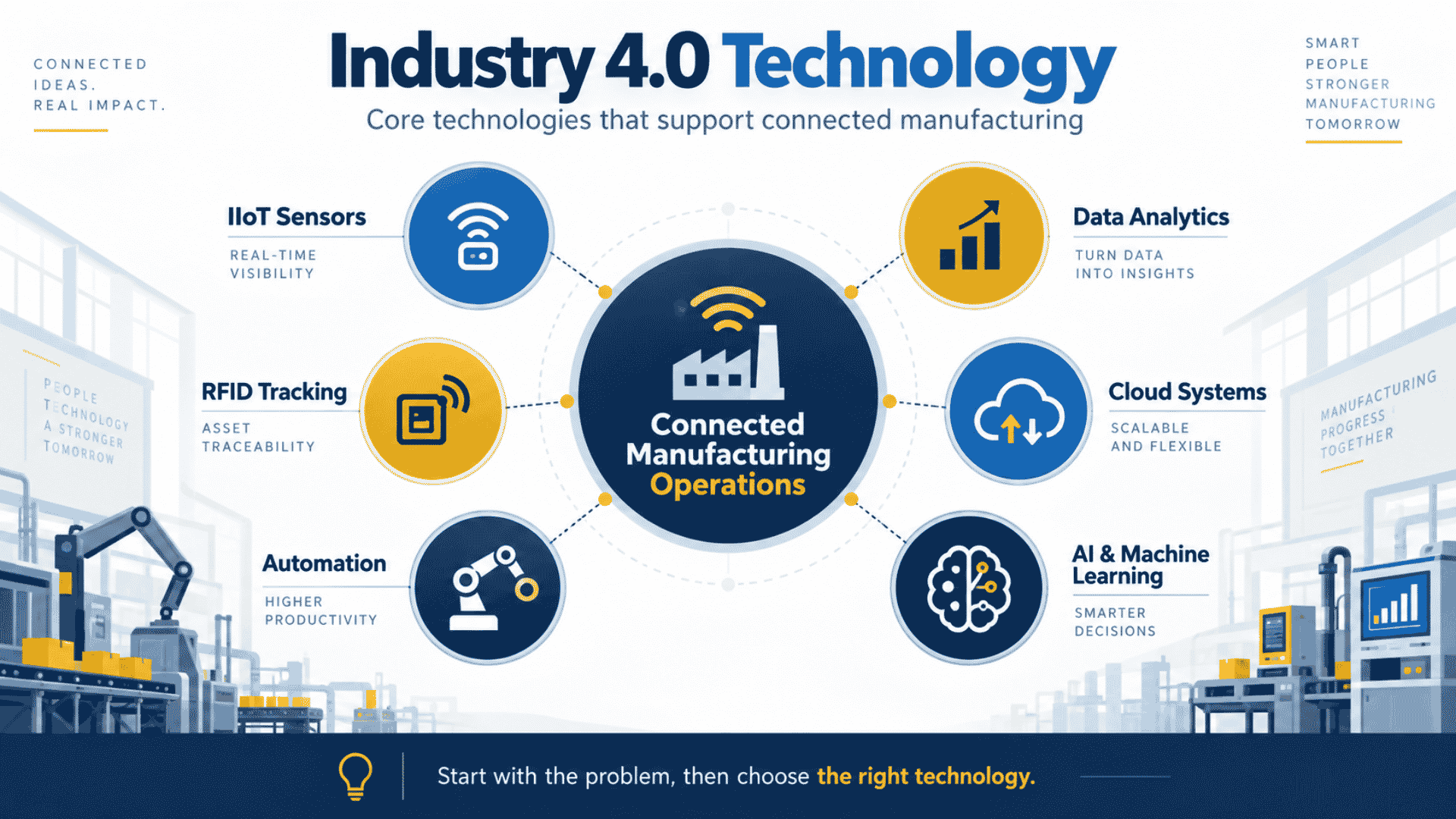
Industry 4.0 Technology: What It Means for Manufacturers in 2026
Industry 4.0 technology connects equipment, software, data, and business systems so manufacturers can improve how work moves through the ope...
Read article
Where Modern Manufacturing Technology Replaces Legacy Systems in Manufacturing in 2026
Modern manufacturing technology does not require replacing everything at once. Many improvements focus on the areas where inefficiencies hav...
Read article
Kick Start Q1 Efficiency: How Midwest Manufacturers Can Integrate Quoting, Inventory, and ERP for a Strong Start to 2026
For many small and mid-sized Midwest manufacturers, the first quarter sets the tone for the entire year. After year-end reporting, budget re...
Read article