
Your operations team wants better production visibility. IT recommends updating an aging application. Inventory needs more accurate data, and leadership is considering automation or AI. Each request has a business reason behind it, but with 2027 budgets taking shape, funding every project at once may not be realistic.
This is where digital transformation in manufacturing becomes a planning challenge. The question isn't simply which technology your business needs. It's which investment should come first, what problem it will solve, and how it supports the improvements that follow. A clear investment plan keeps you focused on operational priorities instead of approving disconnected projects that compete for the same budget.
The short answer
To prioritize digital transformation in manufacturing, start with the operational problems that cost you the most. Score each project on business impact, risk, cost and effort, and dependencies. Stabilize critical systems first, connect existing applications next, then automate workflows and add analytics or AI once your data is reliable. Review the plan every year.
Why does digital transformation in manufacturing need an investment plan?
Digital transformation in manufacturing means using technology, connected systems and reliable data to improve how a manufacturing business operates. It can involve connecting ERP with production systems, replacing manual workflows, modernizing applications, improving inventory tracking, or using operational data to make better decisions. Successful transformation takes more than buying new software.
Consider a manufacturer whose production team wants real-time dashboards. IT is worried about an unsupported scheduling application, and the warehouse needs accurate inventory information. All three projects may be useful, but they may not deserve equal priority. The dashboard could depend on data from the inventory and production systems, and if those systems aren't providing reliable information, the reporting investment may need groundwork first.
The order of technology improvements matters because one project may depend on another. A structured approach helps you invest in the right sequence, manage operational risk, and avoid paying for capabilities you aren't ready to use.
Which manufacturing problems should you solve first?
Before you evaluate software, identify the operational problems that need attention. A new application can look like the answer when the real issue is a disconnected workflow, unreliable data, or a process that has become needlessly complicated. A production manager might ask for a reporting dashboard because daily production information is hard to get. But if production updates are recorded by hand and entered into ERP hours later, a dashboard won't fix the delay. The company may need to improve how production information is captured and shared.
When you review manufacturing technology investments, start with questions like these:
Where are employees repeatedly entering or correcting information?
Which operational issues regularly delay production or customer delivery?
Where do inventory, production and quality records disagree?
Which processes depend on critical spreadsheets or unsupported applications?
What information does leadership need but cannot access reliably?
For each issue, document how often it occurs, who is affected, and what it costs the business in time, errors, delays or risk. That gives you a clearer starting point for deciding which projects deserve funding. If disconnected systems turn up repeatedly, our article on why manufacturing systems don't work together and what to fix first goes deeper.
How do you prioritize manufacturing technology investments?
Manufacturers usually have more improvement opportunities than the annual budget can support. The challenge is deciding which projects deliver meaningful business value and which should wait. A practical approach is to evaluate every proposed investment against four factors.
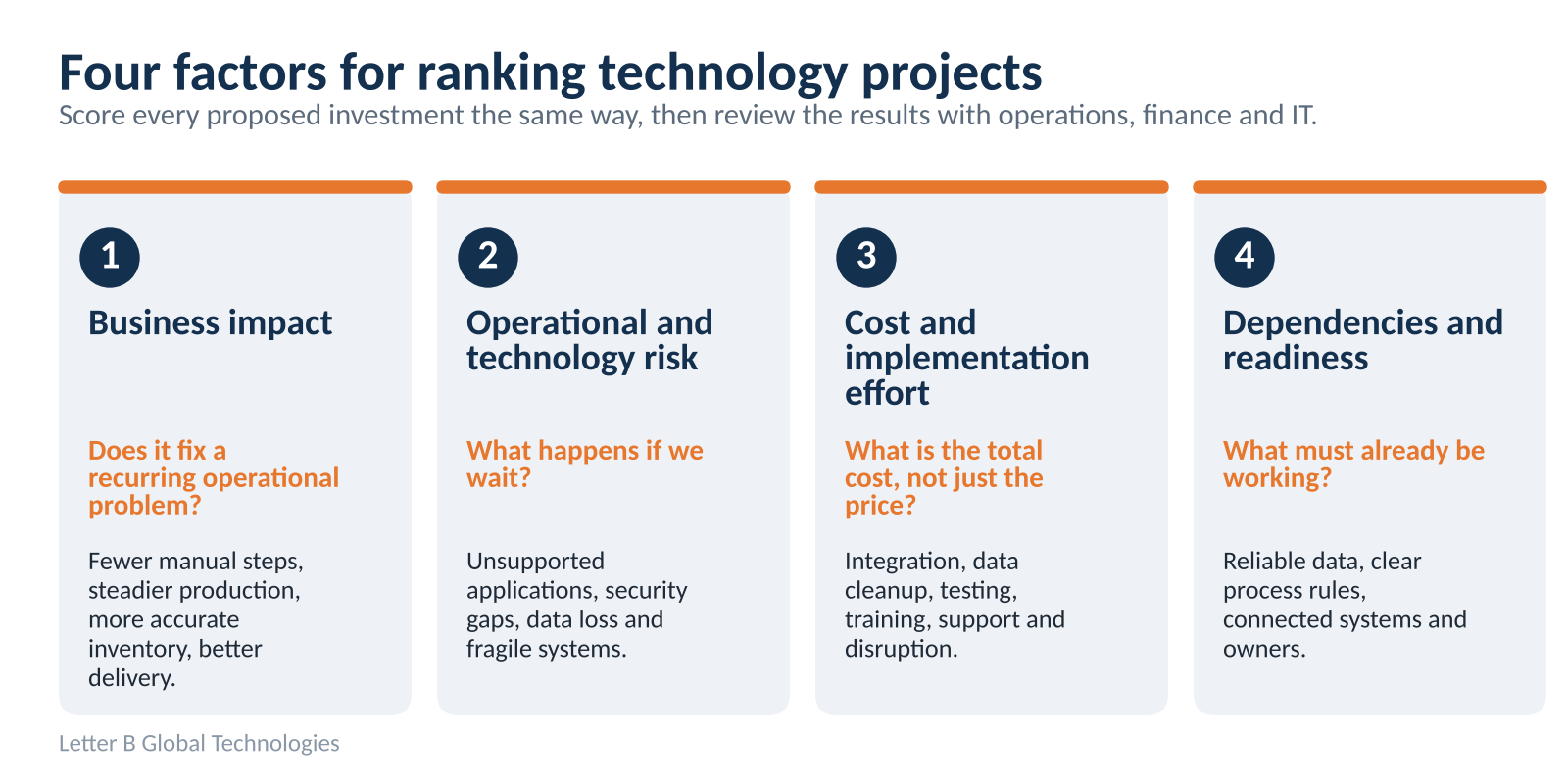
Score every proposed project against the same four factors.
1. Business impact
Start with the operational outcome. Will the project reduce manual work, improve production reliability, strengthen inventory accuracy, or address a problem affecting customer delivery? Consider how often the issue occurs and how many people or processes it affects. A project that addresses recurring production delays may be worth more right now than a dashboard that makes existing reports look better. Business impact should rest on an identifiable operational need, not an expectation that new technology will improve performance.
2. Operational and technology risk
Some investments are necessary because delaying them could create serious problems. An unsupported application managing production schedules may be a bigger risk than a reporting tool with an outdated interface. Review the possible consequences: production interruptions, security vulnerabilities, data loss, and dependence on systems that are getting harder to maintain. Projects that address high-impact risks may deserve priority even when their financial return is hard to estimate.
3. Cost and implementation effort
The purchase or development price is only part of the cost. Also consider integration, data preparation, testing, training, ongoing support, and potential production disruption. A lower-cost solution can become expensive if employees must keep maintaining manual workarounds. A larger project may be justified if it addresses an important operational constraint and reduces repeated maintenance or correction work. Finance and IT should evaluate the total cost of ownership alongside the expected business outcome. Iowa manufacturers can also look at the Manufacturing 4.0 Technology Investment Program. Applicants complete a CIRAS assessment to plan their investment before applying. See Iowa Manufacturing 4.0 funding support.
4. Dependencies and readiness
Some projects can't deliver their intended value until other work is done. Advanced analytics may depend on consistent production data, and workflow automation may need clearer process rules, reliable system connections and defined ownership. Before approving an investment, ask: What must already be working for this project to succeed? The answer keeps you from spending money on tools that rely on systems or information that aren't ready.
Example: a manufacturing technology investment prioritization matrix
The table below shows how a manufacturer might compare several proposed investments.
| Proposed investment | Business impact | Implementation effort | Main dependency |
|---|---|---|---|
| ERP and inventory integration | High | Medium | Data mapping and supported interfaces |
| Replace critical quoting spreadsheets | High | Medium | Documented quoting rules and approvals |
| New production reporting dashboard | Medium | Low–Medium | Accurate, timely production data |
| AI-based production insights | Needs validation | High | Connected data and a defined use case |
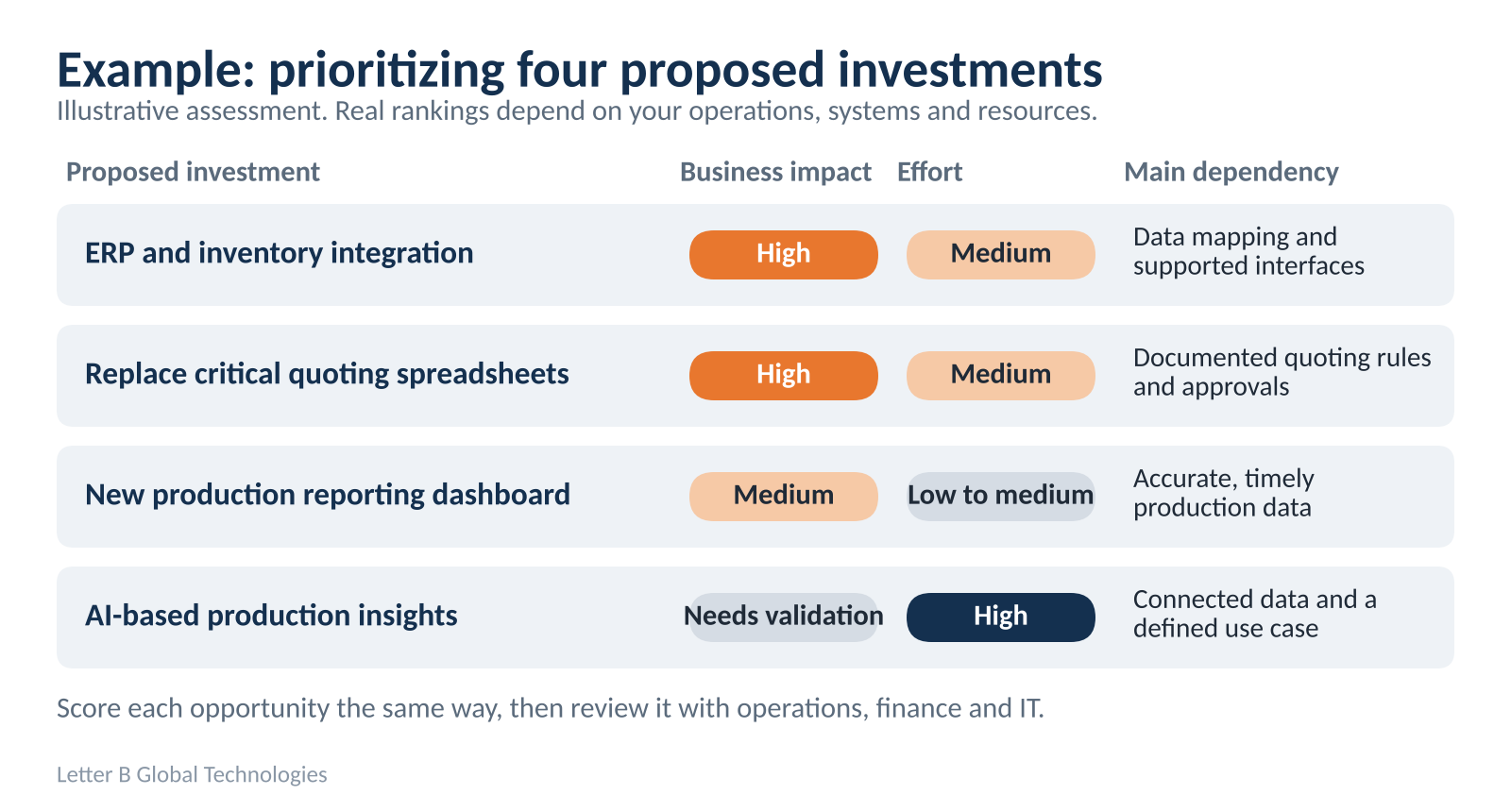
This is an illustrative assessment. Actual rankings should reflect the manufacturer's operational priorities, technical environment and available resources.
Illustrative example. Actual rankings depend on your operations and systems.
A useful next step is to score each opportunity the same way and review the results with operations, finance and IT. The goal isn't to pick the lowest-cost project or the newest technology. It's to find the investment that solves an important problem and prepares the business for what comes next.
Which manufacturing technology projects should come first?
There is no universal order. A company with unreliable production scheduling may have different priorities from one dealing with inventory inaccuracies or excessive manual quoting. Four categories still give you a useful starting point.
These are planning categories, not rigid stages.
Stabilize critical systems. Address applications or infrastructure that create serious operational, support or security risk. Business-critical systems should stay dependable while other improvements are planned.
Connect existing applications. Improve the flow of information between ERP, production, inventory, quality and reporting systems where gaps create costly manual work or unreliable records.
Automate repetitive workflows. Once processes and data are understood, look for opportunities to automate tasks such as approvals, tracking, data entry and reporting.
Optimize with better information. Use more reliable operational data to support analytics, planning and selected AI applications.
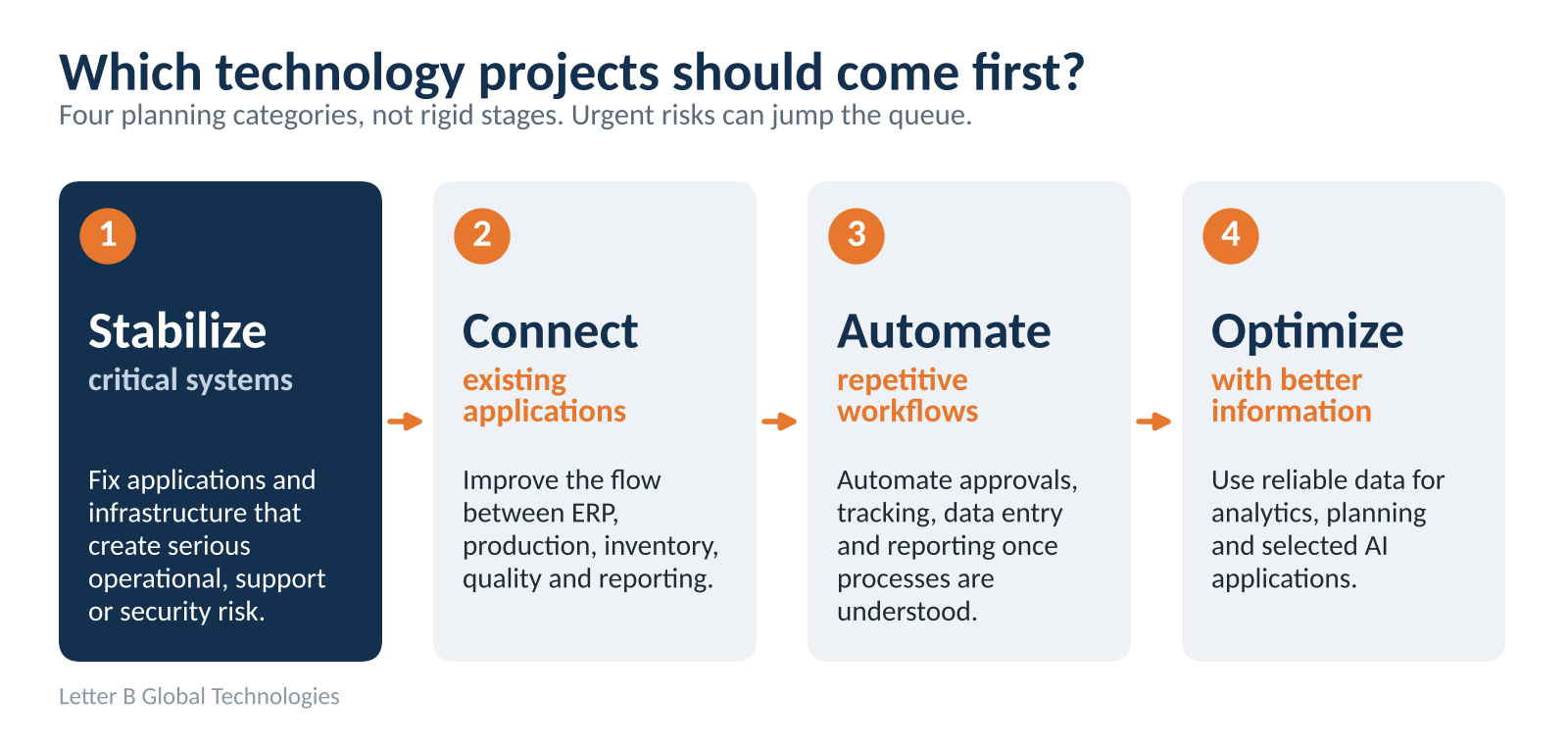
These categories are planning considerations, not rigid stages. An urgent production automation project may be justified before a broader ERP integration program, and a critical unsupported application may need replacing sooner than planned. What matters is understanding how each project affects the operation and what it depends on. Where aging applications create operational risk, our guide to how manufacturers can modernize legacy software without disrupting production explains how to decide whether to retain, improve or replace them, and our legacy modernization services page describes how we help.
What should a 1–5 year manufacturing technology roadmap include?
Once your priorities are clear, organize them into a realistic plan. A manufacturing technology roadmap connects business objectives with planned technology investments, implementation dependencies, budgets and expected outcomes. Instead of treating every improvement as a separate purchase, it shows how projects build on one another. For a manufacturer planning its 2027 budget, an illustrative roadmap might look like this:
| Planning period | Investment focus | Example projects |
|---|---|---|
| 2027: Connect and stabilize | Address immediate operational risks and information gaps | ERP integration, critical spreadsheet replacement, legacy risk remediation |
| 2028–2029: Modernize and automate | Improve workflows and modernize selected applications | Phased software modernization, workflow automation, RFID and inventory tracking |
| 2030–2031: Optimize and scale | Improve visibility and support future growth | Operational analytics, multi-site standardization, practical AI use cases |
Year 1: Connect and stabilize
The first year should focus on the systems and workflows creating the greatest operational problems. That may mean correcting unreliable data exchanges, improving existing integrations, replacing critical spreadsheets, or addressing unsupported applications. The objective is a more dependable foundation and fewer immediate business risks.
Years 2–3: Modernize and automate
With critical issues addressed, you can improve selected applications and workflows. Projects may include phased legacy modernization, automated approvals, production tracking, or inventory management improvements. Each investment should build on the systems, processes and information established earlier.
Years 4–5: Optimize and scale
Later investments may focus on more advanced reporting, operational analytics, multi-site consistency, or AI applications with a clear business purpose. Judge them on expected value and readiness, not on whether they involve emerging technology. If AI is part of your plan, our AI readiness assessment helps you check whether your systems and data can support it.
A five-year roadmap should stay flexible. Budgets, production requirements, business priorities and technology capabilities change, so leadership should review the plan regularly and adjust the sequence when needed.
What mistakes derail manufacturing technology budgets?
Even worthwhile projects can disappoint when manufacturers overlook the conditions required for success. Four mistakes deserve particular attention.
Buying new software without reviewing existing systems
Adding an application may solve one departmental problem while creating another disconnected source of information. Before you buy, determine whether the capability already exists or whether an existing system can be improved.
Prioritizing easy projects instead of important ones
A quick software upgrade may be easier to approve than a complicated integration project. But finishing the easier work doesn't necessarily address the problems limiting production or raising operating costs. Evaluate the expected business impact before deciding what proceeds.
Ignoring the full implementation cost
Budget estimates should include data cleanup, integration, testing, employee training, support, and the effort required from internal teams. These costs can decide whether a project is practical within a given budget year.
Investing in AI without a clear business use case
AI may have practical applications in manufacturing, but every proposed use case needs a specific business purpose. Understand what information the application requires, whether that data is reliable, how its outputs will be used, and who is responsible for oversight. An AI readiness assessment can help you evaluate these conditions before you commit to a larger implementation.
Who should help decide your 2027 technology priorities?
Manufacturing technology planning shouldn't be an IT-only exercise. Technology investments affect production, operating costs, employee workflows and long-term business decisions, so the most useful planning discussions bring several perspectives together.
| Stakeholder | Primary responsibility |
|---|---|
| Owner or CEO | Align investments with growth and business priorities |
| COO or plant leadership | Identify operational constraints and improvement opportunities |
| IT director or ERP owner | Evaluate system condition, integrations and technical risks |
| CFO or finance leader | Review costs, funding and financial justification |
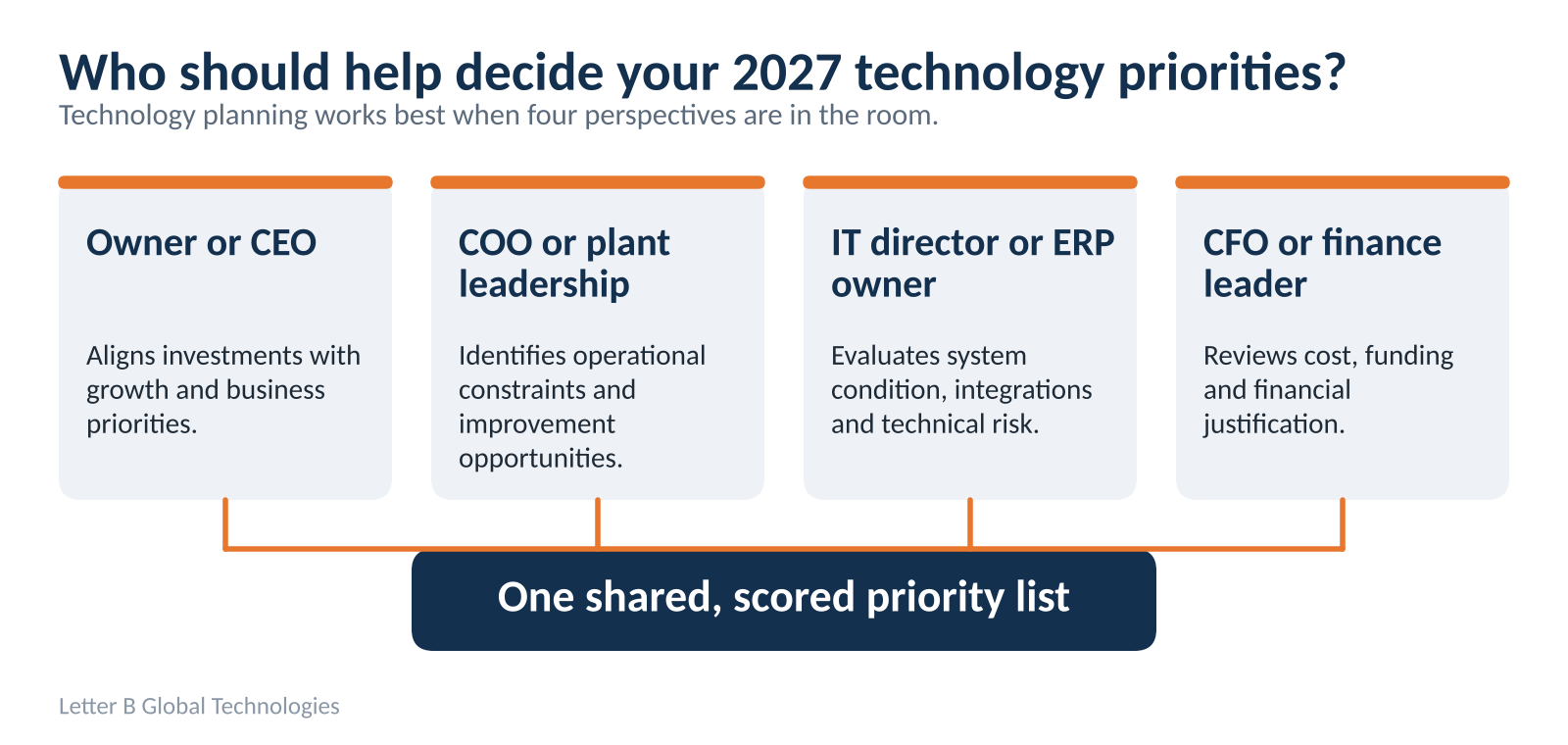
Four perspectives, one priority list.
Each group should be able to explain what success means for a proposed project. Operations may want fewer production delays, while finance needs to understand the investment and its expected financial impact. IT must decide whether the improvement is technically feasible and what other systems it could affect. Bringing these views together produces a plan the business can realistically support.
Turn your 2027 technology priorities into a practical plan
Digital transformation in manufacturing doesn't have to start with a major system replacement or an expensive new platform. It starts with understanding where technology is limiting operations, which improvements matter most, and how to implement them in the right sequence.
Letter B's Technology Planning Review helps manufacturers evaluate existing ERP, production, inventory, quality and reporting systems. The review identifies risks and opportunities, then organizes priorities into a practical 1–5 year technology roadmap. Before you finalize your 2027 technology budget, make sure your investments address the problems that matter most.
Book a Technology Planning Review
Learn more about Letter B's manufacturing solutions.
Enjoyed this insight?
Explore how Letter B turns the same challenge into an operational win.
Common questions about manufacturing
It means using technology, connected systems and reliable data to improve how a manufacturing business operates. Examples include connecting ERP with production systems, replacing manual workflows, modernizing applications, improving inventory tracking and using operational data to make better decisions.
Related insights
View all
How Manufacturers Can Modernize Legacy Software Without Disrupting Production
How manufacturers can modernize legacy software without stopping production: five warning signs, a six-step process and a 2027 budget roadma...
Read article
Why Your Manufacturing Systems Don't Work Together and What to Fix First
See why manufacturing systems become disconnected, how ERP and shop floor data gaps affect operations, and what to fix first before investin...
Read article
What Is Smart Manufacturing? Practical Examples for Small and Mid-Sized Manufacturers
A plain-English guide to smart manufacturing: connected systems, IoT sensors, RFID tracking, predictive maintenance, and where smaller plant...
Read article